Showing posts with label cannon. Show all posts

Monday, February 20, 2017

Government Museum Complex, Chennai

The Government Museum Complex in Chennai is a hub of human history and culture. It is located in the neighbourhood of Egmore.


The complex has both old and new sections. Some of the sections in the museum are as old as 1851. Among them, the colossal Museum Theatre is one of the most impressive.


The National Art Gallery, Government Museum, Bronze Gallery, Children Museum are present in the complex.


There are several Cannons at the museum complex.


The fossil trunk displayed here is about twenty million years old. Tree carried by rivers were deposited inland lakes and were transformed into fossil tree trunks by silica replacing the woody matter.

Monday, August 1, 2016

Kila Shikan, Devgiri Fort

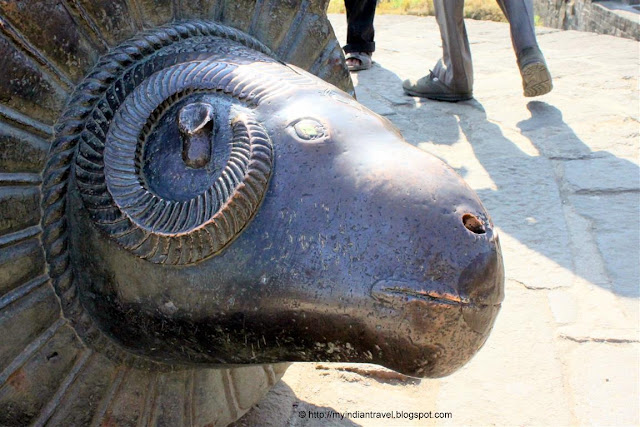
The 14th century Devgiri Fort is known for various bronze canons found all around the fort. One such canon is Kila Shikan.


The canon located in a strategic place named so mean Fort Breaker. It lies on a stone platform.


The impressive canon has a ram-head.


The canon has the name inscribed on it in Persian.


Wednesday, April 20, 2016

Images of India - 160

A glimpse of heritage monument of India in black and white. Check other posts that will give you more details about this monument.


A canon in front of Junagadh Fort Palace in Bikaner

Monday, August 17, 2015

Fortem do Mar, Diu

The majestic Portuguese Fort in Diu better known as the Fortem do Mar at the eastern tip of the Diu. Built in 1535 by Portuguese during their colonial rule of the Diu island this fort was known to provide a strategic vantage point against enemy attacks. The original fortification was constructed under Nuno-da-Cunha and was later rebuilt by the Viceroy D Joao-de-Castro after 1546 AD.


The fort is entered through double gateways, one after the outer moat and the other after the inner moat. The gateways have impressive Portuguese plaques and sculptures of lions.


The fort is one of India’s best-known Portuguese military architecture. The fortified walls consist of 7 bastions on which guns are mounted.


The fort built along the Arabian Sea coastline is surrounded by sea on three sides. It is circular in shape having 20 feet high and 12 feet thick walls with double moats, an outer moat and an inner moat. 


There are a few ruined churches found inside the fort. They are simple in appearance and meant for the resident officers to prey. The fort with its double moat, a splendid array of cannons, small chapels. The notable places of interest in the fort are:
  • St. George bastion
  • St. Luzia Bastion
  • St. Tiago Bastion & Chapel
  • Lighthouse
  • Canons of the Fort

Thursday, July 17, 2014

Daria Daulat, Srirangapatna

Daria Daulat at Srirangapatna was the summer palace of Tipu Sultan that was built in the year 1784 A.D.  The palace is square in plan, built on a raised stone plinth, with teak pillars running along the outer edge, enclosing a corridor. 


There are two recessed bays on the northern and southern sides overlooking two large hall, through canopied balconies. The living spaces on the two floors of the palace are accessible by four staircases.


All the walls and ceilings of the entire palace are painted. The paintings depict the victories of Hyder Ali and Tipu over the British, and the durbar scenes of Tipu's contemporaries like the Rani of Chitoor, the Raja of Tanjore, The Raja of Banaras, Unfortunately photography is not allowed inside the palace.


I could capture some beautiful paintings which were near the entrance to the palace. After the death of Tipu Sultan in 1799, this palace was occupied by Colonel Arthur Wellesley.


Monday, March 17, 2014

Palaces of Junagarh Fort, Bikaner

Junagarh Fort at Bikaner encompasses several places each one surpassing other in magnificence. The fort was constructed between 1588 and 1593 by Raja Rai Singh, a general in the army of Mughal emperor. The subsequent Maharajas have added luxurious suites to this palace. 


The palaces within the fort are on the southern side and make a picturesque ensemble of towers, courtyards, balconies and windows. A major feature of fort and palaces is the superb quality of stone carving.


Karan Mahal, built in 1680 classic Mughal style was is covered with rich Rajput elaboration of Mughal style in terms of the purity of white marble and stucco design. 


Anup Mahal has magnificent decorative art work in this palace with gold vermilion varnished work. There are beautiful motifs treated completely in gold and by mirrors and mirrors or glass mosaic. It also has one throne where the ruler would sit and meet his foreign guests and highly placed officials. Old and antique carpets adorn the floor. 


Gaj Mandir has walls that are covered with elaborate Mughal niches and panels enclosed by a framework of marble plaster slabs, which are carved into various Mughal open-work floral designs behind which mirrors have been placed.


Badal Mahal is stylized blue-and-white clouds, and it reflects the longing for rain in an arid area. Phool Mahal is the oldest part of the palace that has decoration with motifs of trays, flower vases. Inside the rooms the interior walls are decorated with stucco work and glass inlay works.

Wednesday, October 30, 2013

Images of India - 34

A glimpse of heritage monuments of India in black and white. Check other posts that will give you more details about this monument.


Canon inside the Meharangarh Fort at Jodhpur 

Monday, February 4, 2013

Cannons of Daulatabad Fort

In India, cannons were used effectively for the first time in the First Battle of Panipat in 1526. Since then, cannons have become an important component in the battles. The earliest cannons were made of bronze. The range of these cannons varied from 1 to 3.5 kms. 


These cannons were either mounted them on bastions or wooden carriages, with four or two wheels and drawn to the battlefields. 


A large number of cannons are found at Daulatabad Fort 15 kms from Aurangabad, some in their original places like bastions on fort walls and circular towers while others were collected from various locations. Now they have been displayed in the courtyard near the entrance gate.


The cannons range from large to heavy guns. These cannons are made of either bronze or iron - both wrought and cast. Other noteworthy cannons here are Durga cannon, Ram Cannon which is the largest artillery in this fort.

Thursday, October 20, 2011

Shaniwar Wada, Pune

Shaniwar Wada in Pune is the most magnificent and stately mansion built chiefly as the residence of the Peshwas. The foundation of the original residence was laid by Bajirao - I in 1730 A.D. and the construction completed in 1732 A.D. His successors made several additions such as fortification walls, with bastions and gates, court halls and other buildings, fountains and reservoirs in 1828 A.D.
However, fire gutted the building in this place and what now remains is their plinths and fortification wall with five gateways and nine bastions that enclosed the whole complex. Nobody knows what caused the fire. The complex had an impressive lotus-shaped fountain in the garden. The location of this can be seen in the below image (the central part near the green cover where no people are present).
The main gate of the complex known as Dilli Darwaza faces north towards Delhi. This strongly built entrance has massive doors, large enough to admit elephants outfitted seating canopies. Each door has seventy-two sharp twelve-inch steel spikes arranged in a nine by eight grid which are at the height of elephants forehead. On the right door there is a small man-sized door for usual entries and exits.
The invading army can not charge through the open main gates as there is a sharp right turn followed by a sharp left before entering into the central complex. This would provide a defending army with another chance to attack the incoming army, and to launch a counterattack to recapture the gateway.

One of the brass canons with carvings on them in the complex.

Monday, August 1, 2011

Malik-e-Maidan, Bijapur

There are many interesting sights in Bijapur (State: Karnataka). One among them is Malik-e Maidan.

Malik-e Maidan ("Lord of the Battlefield") is a massive cannon located on the top of the Sherzah Burj. It was considered to be largest weapon in medieval times. The 8.5m long and 1.6m wide cannon weights 55 tons.

The head of the cannon is fashioned into the shape of a lion's head with open jaws trying to devour an elephant. This huge cannon is a cast of alloy of copper, iron and tin.

The outside surface is shining and adorned with inscriptions in Persian and Arabic.

Thursday, December 2, 2010

Jaswant Thada, Jodhpur

Jodhpur (State: Rajasthan) has many historical monuments of interest. One of them is Jaswant Thada, located on the long road that takes one to the Mehrangarh Fort. 

This monument is built by Sardar Singh in 1899 in memory of Maharja Jaswanth Singh II. This ornamental cenotaph is entirely built using white marble. It is a traditional cremation ground of Jodhpur rulers.
The above image was taken from the fort. The monument in the empty hilly region is Jaswant Thada.

Monday, May 17, 2010

Jhansi Fort -2

The fort of Jhansi popularly known as Jhansi Fort is built on hilltop in 1613. The Fort is an architectural delight for his sheer size and the structure. The fort spread across 15 acres of land is about 312m in length and 225m in width. (Click on the images for bigger picture)

There are 10 gates providing access to this fort. Some of these are Khanderao Gate, Datia Darwaza, Unnao Gate, Jharna Gate, Laxmi Gate, Sagar Gate, Orcha Gate, Sainyar Gate and Chand gate.

Rani Laxmi Bai of Jhansi, inspired patriotism in heart of all her subjects. This particular cannon in the above image is operated by Moti Bai a dancer in the royal court. While defending the fort from the enemies not only men, even women of the state fought bravely.


Monday, January 18, 2010

Jai Vilas Palace, Gwalior

From Bhopal after touring Bhojpur and Bhimbetka we reached Gwalior overnight. In Gwalior we first visited nearby destinations like Padavali and Mitavali. Some time in the afternoon we visited this magnificent palace before visiting the fort. This palace is located in the city outside the premises of the fort.

Jai Vilas Palace, is an Italianate structure combining the Tuscan and Corinthian architectural modes. This palace was designed by Lt. Col. Sir Michael Filose and was bui
lt in 1809. The part of the palace is occupied by the Royal Scindia family.

About 35 of the rooms have been converted into the Scindia Museum. A splendor of a different kind exists in this palace. These rooms, are so expressive the royal lifestyle, the past comes alive. The museum provides a glimpse of the rich culture and lifestyle of the royal India.

The palace has various rooms each one decorated in its own way with different colors and exquisite furniture. One such room is shown below. The furniture in this are made of crystal.

Room with crystal furniture

In the museum on display are several belongings of the Royal family. Some of the
antiques are glass cradle from Italy used for the baby Krishna on each Janmashtami celebrations, and swords that were once worn by Emperors Aurangzeb and Shah Jahan.

golden footwear

These are, besides, personal mementos of past members of the Scindia family: the jeweled slippers that belonged to Chinkoo Rani, four-poster beds, gifts from practically every country in the world, hunting trophies and portraits.

In the next section we will discover other rooms of this beautiful palace.

Wednesday, June 10, 2009

Jaigarh Fort, Jaipur

Along with palaces, and other attractions we set our eyes on exploring the most important tourist attractions of the city i.e., the forts. The second fort in Jaipur we followed after the Nahargarh Fort is Jaigarh Fort.

This fort is very rugged in structure and is of very less artistic importance. It has huge fort walls, watch towers, palaces and temples. The palace is now converted into museum. This was built in 1726 by Sawai Jai Singh. This fort is also known as Fort of Victory. It was built mainly to safeguard Amber Fort from the enemy attacks which is more of artistic in nature. The fort is perched on a cliff and the walkways inside the fort provide the breathtaking views of the surroundings.

The World's largest cannon on wheel, Jaiban, is to be found here. There is a huge water pit close to the cannon at a lower level. It is believed that the sound generated by firing this cannon was so huge that people close by can become deaf. After firing from this cannon the person has to jump in the water pit to save himself.


View of cannon Jaiban kept under shade and covered by fence

Also of interest is the intricate water supply and storage system, which is considered a marvel of planning.


Next we will explore the Amber Fort.

P.S: December is the month when lot of tourists land in Rajasthan. So if you really want all the arrangements to be done properly this has to be done before October end.