Showing posts with label painting. Show all posts

Monday, July 17, 2017

Bangalore Palace

Bangalore Palace, is a magnificent palace located in Bangalore that still retains its old world charm. Construction of a palace building was started in 1874 and completed by 1878 on a land of area 454 acres.


The palace with a floor area of 45000 sqft was built in Tudor style architecture with fortified towers, battlements and turrets. In the later years, Maharaja Jayachamaraja Wadiyar added some portions outside of Durbar Hall during his reign. 


All together there are 35 rooms in palace and most of them are bed rooms. The first floor has an elaborate hall known as the Durbar Hall that can be reached by climbing a decorated staircase. The walls along the staircase are adorned with paintings.


Durbar Hall is a sprawling hall where the king used to address the assembly. One side of the hall contains stained glass windows in Gothic style. The yellow color is used profusely and the walls and the sofa set in the hall are in yellow. 


The furniture are neo-classical, Victorian and Edwardian in style. They were bought from John Roberts and Lazarus. 


The interior walls of the palace are adorned by 19th century old paintings. Some of those are also Greek and Dutch paintings.


The interiors were decorated with elegant wood carvings, floral motifs and relief paintings on the ceiling. The palace also has beautiful  work of arts and crafts on display.

Monday, July 11, 2016

Cave No. 16, Ajanta

The excavation of Cave No. 16 at Ajanta was ordered by Varahadeva, the minister of King Harishena in the late 6th century A.D. The entrance gate to this cave is carved with an elephant on either side.


This monastery with its colossal hall, ornate doors and windows, beautifully painted galleries, sculptures, ornamented pillars is a architectural beauty that makes it one of the most striking in the series. 


This is a monastery that consists of a central hall surrounded by 14 cells on three sides, vestibule and a sanctum for Buddha image. The veranda has octagonal columns. The sanctum of this cave is devoid of doorway and antarala. The sanctum has Buddha image seated in pralambapadasana. 


Originally the entire cave was beautifully painted but now very little of the painting now remain. Several interesting scenes from the life of Buddha such as the infant Buddha, Siddhartha at school- drawing the bow, miracle of Sravasti; and other Jataka stories are depicted.


The "Dying Princess" is considered to be one of the important paintings produced in this cave. The princess is wife of Nanda the cousin brother of Buddha. She fell ill after hearing the decision of her husband that to renounce the crown and to become a monk. The dying woman with drooping head, half-closed eyes, and languid limbs, reclines on a bed.


Apart from painting there are beautiful sculptures in the cave at the juncture of pillars and ceiling.


Wednesday, March 4, 2015

Images of India - 103

A glimpse of India in black and white. This is a picture of Warli painting. They are folk paintings from Maharashtra and are very different from other folk and tribal paintings in India.


Wednesday, January 28, 2015

Mandwa Haveli

As I said earlier we reached Mandwa only in the night we checked into the hotel directly. We had booked in Mandwa Haveli which is close to Sonathia Gate and Subhash Chowk.


This 19th century haveli has been restored beautifully. In this magnificent haveli the rooms are surrounding a painted courtyard. We truly enjoyed our stay here.


The paintings on the interior walls of the courtyard are very beautiful. Even the paintings on the entrance to the haveli are awesome.


Wednesday, January 14, 2015

Cave No. 34, Kanheri

In Mumbai, there are more than 100 caves at Kanheri of which many of them have beautiful carvings. One of the interesting cave among them is Cave No. 34. This cave dates between to 5th – 6th centuries A.D.


This cave has a open courtyard in the front with pillars that are carved a little. 


This is the only cave where remains of paintings are found on the ceiling. 


Here Buddha is shown in Bhumi-Sparsha-Mudra. This is only seen in paintings here but not as carvings. 

Thursday, July 17, 2014

Daria Daulat, Srirangapatna

Daria Daulat at Srirangapatna was the summer palace of Tipu Sultan that was built in the year 1784 A.D.  The palace is square in plan, built on a raised stone plinth, with teak pillars running along the outer edge, enclosing a corridor. 


There are two recessed bays on the northern and southern sides overlooking two large hall, through canopied balconies. The living spaces on the two floors of the palace are accessible by four staircases.


All the walls and ceilings of the entire palace are painted. The paintings depict the victories of Hyder Ali and Tipu over the British, and the durbar scenes of Tipu's contemporaries like the Rani of Chitoor, the Raja of Tanjore, The Raja of Banaras, Unfortunately photography is not allowed inside the palace.


I could capture some beautiful paintings which were near the entrance to the palace. After the death of Tipu Sultan in 1799, this palace was occupied by Colonel Arthur Wellesley.


Sunday, June 22, 2014

St. Joseph’s Church, Aluva

St. Joseph’s Pontifical Seminary at Aluva is a major seminary of the Syro-Malabar Church of the St. Thomas Christians. 


The seminary has a cemetery that is a nice sturdy structure. This is a huge chapel which has been painted white in the interiors.


The church has beautiful and colrful stained glass windows. One of the colorful glass winow has Aeterni Sacerdotii on display.


X'mas is celebrated with great fan fare here.

Thursday, June 12, 2014

Cave No. 10, Ajanta

Cave No. 10 at Ajanta is also a chaityagriha similar to  Cave No. 9. It has a similar shape but larger in size. This is a large chaityagriha and inscription on its facade dated to the 2nd century B.C.


This was the the first cave discovered in Ajanta in April 1819. John Smith, a British Army Officer noticed the arch of this cave and this led to the discovery of other caves here.


It is apsidal on plan and consists of a large central hall, nave flanked by two aisles 
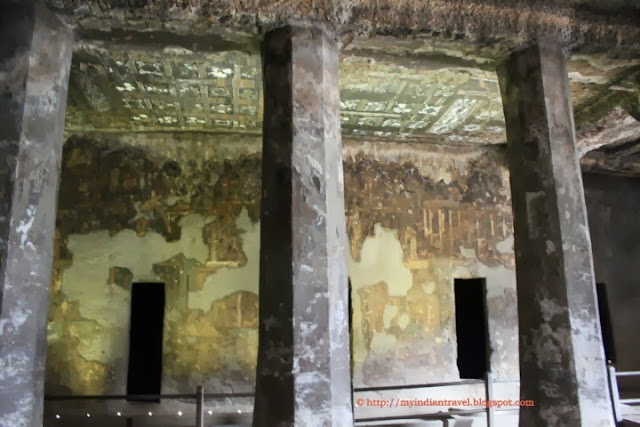
separated by a row of 39 octagonal pillars. The paintings on the pillar contain Buddha figure. 
At the apsidal end is a rock stupa. 


The cave consists of two periods of paintings, the earlier dated to 2nd century B.C and the later 4th – 6th century A.D.


The whole of this cave has been painted but only few painting were retained, which they were at one time completely adorned. There are paintings of Budha poses in the ceiling.

Monday, March 17, 2014

Palaces of Junagarh Fort, Bikaner

Junagarh Fort at Bikaner encompasses several places each one surpassing other in magnificence. The fort was constructed between 1588 and 1593 by Raja Rai Singh, a general in the army of Mughal emperor. The subsequent Maharajas have added luxurious suites to this palace. 


The palaces within the fort are on the southern side and make a picturesque ensemble of towers, courtyards, balconies and windows. A major feature of fort and palaces is the superb quality of stone carving.


Karan Mahal, built in 1680 classic Mughal style was is covered with rich Rajput elaboration of Mughal style in terms of the purity of white marble and stucco design. 


Anup Mahal has magnificent decorative art work in this palace with gold vermilion varnished work. There are beautiful motifs treated completely in gold and by mirrors and mirrors or glass mosaic. It also has one throne where the ruler would sit and meet his foreign guests and highly placed officials. Old and antique carpets adorn the floor. 


Gaj Mandir has walls that are covered with elaborate Mughal niches and panels enclosed by a framework of marble plaster slabs, which are carved into various Mughal open-work floral designs behind which mirrors have been placed.


Badal Mahal is stylized blue-and-white clouds, and it reflects the longing for rain in an arid area. Phool Mahal is the oldest part of the palace that has decoration with motifs of trays, flower vases. Inside the rooms the interior walls are decorated with stucco work and glass inlay works.

Monday, January 6, 2014

Cave No. 17, Ajanta

This beautifully painted monastery, Cave No. 17 in Ajanta is donated by a feudatory prince Upendragupta under Vakataka King Harishena in the late 5th century A.D. 


It has some of the most magnificent paintings of Ajanta. The porch is a stream of jataka narratives and early Buddhist themes. Over the door are eight Buddhas, including Maitreya, the next Buddha to come. Even the sculptures on the door frame are beautiful.


The left end of the porch once had a magnificent kalachakra - the Wheel of Rebirth, showing the different possibilities of reincarnation according to your actions, and the possibilities of elevation.


It consists of a spacious hall surrounded by 17 cells on three sides, a vestibule and a sanctum containing the image of Buddha. The hall supported by twenty octagonal pillars and is pierced with three doors and two windows.  The cave houses some of the well preserved paintings. Even though the ceilings are beautifully painted.


One famous Jataka tale called the Matropaksha Jataka tells the story of a Bodhisattva born as a six tusked white elephant that is attacked by warriors commissioned by the queen of Banaras. The Elephant-Bodhisattva removes his own tusks to present them to the queen.

Thursday, October 17, 2013

Amba Vilas Palace, Mysore

There are several palaces at Mysore and most famous among them is Amba Vilas Palace. It is popularly known as Mysore Palace. When in city people never fail to visit this prominent tourist attraction.


This palace here is within the old fort area and it is the official residence of Wodeyars, who ruled the place for over seven centuries. This palace was built for the first time in the 14th century. In the year 1638 the original wooden palace got damaged by a lightning strike. It was repaired and extended later. 


The palace is surrounded by a large garden. The architectural style of the palace follows Indo-Saracenic, and blends together Hindu, Muslim, Rajput, and Gothic styles of architecture. 


It is a three-storied stone building of fine gray granite with deep pink marble domes that was designed by Henry Irwin. The facade has seven expansive arches and two smaller ones flanking the central arch, which are supported by tall pillars. 


Above the central arch is an impressive sculpture of the goddess of wealth, prosperity Gajalakshmi, with her elephants on either side.


The interior of Mysore Palace is richly carved, intricate, colorful and architecturally thrilling. The palace has several elegant and impressive rooms.


One enters the palace through Doll’s Pavilion where a traditional dolls from the 19th and early 20th centuries are on display. Private Durbar was used by the king for private audience and is one of the most spectacular rooms. 


Kalyana Mantapa a Octagonal shaped hall where all royal weddings, birthdays and ceremonial functions were celebrated. In this room there are 26 paintings that depict Dasara procession. In Public Durbar Hall the King would host major ceremonial gatherings in this hall. It has cool marble floor, through colonnades of cusped arches supported by intricate and elaborately painted columns. 


Although tourists are allowed to visit the palace, they are not allowed to take photographs inside the palace. 

Monday, October 14, 2013

Namdroling Golden Temple, Bylakuppe

Located inside Namdroling Nyingmapa Monastery at Bylakuppe is the famous Namdroling Golden Temple. The path to the temple passes through a sprawling garden. 


The temple looks grand with a giant rainbow arch over it. The interior of this temple is amazing and brightly colored with paintings all over the place. The walls are intricately decorated with patterns and murals of Tibetan Buddhist themes. 


The altar of the Golden Temple contains the imposing  three golden images. They are Guru Padmasambhava (on the left), Lord Buddha Sakyamuni and Amitayus (on your right).


The statue of Lord Buddha is 60ft in height where as the height of other two statues are 55ft. Theyt are made of copper, plated with gold. Inside the statue are scripture, relics of great beings, small clay mould stupas, and small  statues.