Showing posts with label cave. Show all posts

Monday, September 11, 2017

Buddhist Caves, Junagadh

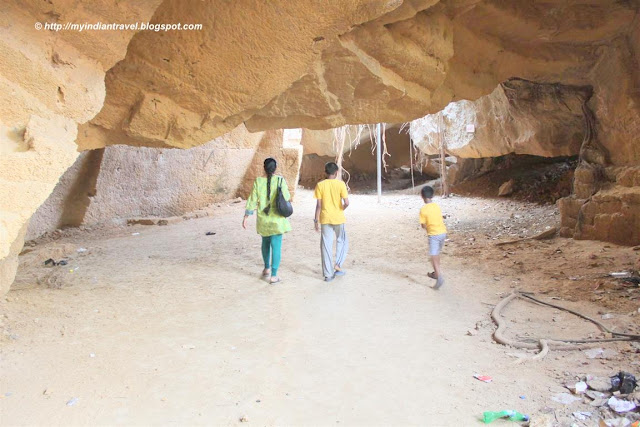
Buddhist Caves in Junagadh, close to the mosque inside the Uppekot Fort is fine example of Buddhist rock cut architecture of 2nd century A.D. These caves are on the eastward slope leading to the Adi-chadi Vav. 


These caves are scooped out in three tiers from surface downwards, with all members of each gallery shown in semi-relief. There are three rock-hewn chambers, each open to the skies. The caves feature many monastic meditation cells.


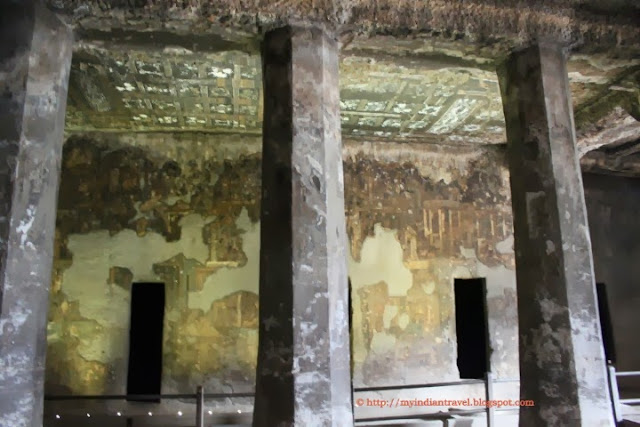
Only two of the stories have regular floors. The main hall of the lowest storey is partly open to the skies and contains exquisitely carved pillars, whose base, shaft and the capital contains unique decorative designs. 


The pillars, having spiral ridges on their shaft, octagonal plinth bases and floral ornamented capitals with animal figures etc, represent the main Satvahana art traditions on one hand, and in the exotic, Grecco-synthian trends on the other hand.


There are still some traces of beautiful carvings in the cave that is built across several floors.

Thursday, August 17, 2017

Pandava Caves, Aravelam

The ancient Caves in Aravelam is must visit place for history buffs. These 6th century caves are small that have 5 compartments. The Buddhist monks have carved these caves out of a single hard laterite rock. 


These caves are also known as the Pandava caves as it is believed that Pandavas have stayed here at some point during their 12 year exile as described in the Mahabharata.


At a later period these caves have been converted to shaivite caves. 


Shivlings carved out of granite of different shapes and sizes have been placed in each of these caves. These Shivlings are placed on raised platforms.


Monday, June 26, 2017

Veera Brahmam Cave, Yaganti

Yaganti has many places of historic importance apart from the Uma Maheswara Swamy Temple. There are several caves in the hills surrounding and one of them is Veera Brahmam Cave.


To reach the cave, one has to climb a series of steep steps that are not too steep. 


Once one reach the top to enter inside one has to bend half over. Inside the cave there is small Shiva Linga and Nandi in front of it.


This is the cave where saint Sri Potuluri Veera Brahmendra swamy wrote some of his Kala Gnaanam (prophecy).

Wednesday, March 1, 2017

Agastya Cave, Yaganti

Yaganti has many places of historic importance apart from the Uma Maheswara Swamy Temple. From the table when one looks up from the temple, we can see several caves in the massive rocks surrounding the table. Even though most of them are inaccessible, there are 3 caves that are accessible.


These caves are sacred and one such important cave is Agastya Cave where it is believed that Sage Agastya had meditated. To reach the cave, one has to climb a series of steep steps and it is easy to climb them to reach the top without intermediate breaks. There is a small Shiva Linga inside the cave.


The light streamed in through the gaps in the cave and in the distance, The view of the temple from the stairs of these cave is amazing.


Monday, August 8, 2016

Dashavatara, Ellora

In Ellora the cave numbered as 15 is a Hindu Temple. To reach this magnificent Cave No. 15 one has to climb up series of steps where the entire court has been hewn out of the solid rock with a curtain wall across in front of it, and a sacrificial hall in the middle. This cave originally a Buddhist monastery is popularly known as Dashavatara.


This cave is a double storey, the lower part measuring 95 feet in length is a few feet above the level of the court, and it is supported by 14 square pillars. The upper floor is 95 feet wide and 110 feet deep inclusive of the vestibule of the shrine, supported by 44 square columns.


The two pillars in the front are carved with floral ornamentation,  including dwarfs, snakes etc.


In the eighth century was converted into a Hindu sanctuary under the patronage of the Rashtrakuta king Dantidurga. The beautiful carvings in this cave were done under the patronage of the Kalachuri, the Chalukya and the Rashtrakuta dynasties between the sixth and the ninth centuries. This cell has a huge sculptress of The second has Siva and Parvati. 


One of the cell has Varaha holding the Prithvi on his hand, with three other snake figures below it.


Wednesday, July 20, 2016

Naida Caves, Diu


Naida caves in Diu are within a short distance from the town. These caves totalling about 11 is a intriguing network of square hewn hollows.


These caves have a natural opening that allows sunlight to enter the caves, making out to be a visual delight. A labyrinth of orange rock caves, look beautiful with sunbeams gleaming in through the open areas.


It is not clear how these caves are formed. The studies show that the caves were formed due to geological irregularities and processes over a significant amount of time.


It is believed that when the Portuguese ruled over Diu, they broke down sections of a huge rock formation, that they used for construction of the Diu Fort. This resulted in the formation of these caves.


Monday, July 11, 2016

Cave No. 16, Ajanta

The excavation of Cave No. 16 at Ajanta was ordered by Varahadeva, the minister of King Harishena in the late 6th century A.D. The entrance gate to this cave is carved with an elephant on either side.


This monastery with its colossal hall, ornate doors and windows, beautifully painted galleries, sculptures, ornamented pillars is a architectural beauty that makes it one of the most striking in the series. 


This is a monastery that consists of a central hall surrounded by 14 cells on three sides, vestibule and a sanctum for Buddha image. The veranda has octagonal columns. The sanctum of this cave is devoid of doorway and antarala. The sanctum has Buddha image seated in pralambapadasana. 


Originally the entire cave was beautifully painted but now very little of the painting now remain. Several interesting scenes from the life of Buddha such as the infant Buddha, Siddhartha at school- drawing the bow, miracle of Sravasti; and other Jataka stories are depicted.


The "Dying Princess" is considered to be one of the important paintings produced in this cave. The princess is wife of Nanda the cousin brother of Buddha. She fell ill after hearing the decision of her husband that to renounce the crown and to become a monk. The dying woman with drooping head, half-closed eyes, and languid limbs, reclines on a bed.


Apart from painting there are beautiful sculptures in the cave at the juncture of pillars and ceiling.


Monday, September 21, 2015

Cave No 41, Kanheri

Cave No 41 of Kanheri is one of the important cave in the area that is built sometime around 3rd century B.C. The cave consists of a porch in the front followed by a verandah and a hall. The porch is supported on four pillars of square shaft topped with cushion capitals and square abacus. 


The veranda can also be reached from the sides of this front porch. The hall is approximately 26 feet long and 22 feet wide with many Buddhist icons carved all around. There is a cell in the centre of the back wall, inside which a Buddha image flanked with two attendants is carved. 


One of the important sculptures here is Litany of Avalokiteshvara and the Eleven-headed Avalokiteshvara. Unfortunately the Litany of Avalokiteshvara is much defaced hence the ‘Eight Fears’ are almost disappeared.


Eleven-headed Avalokiteshvara is only one of its kind in India. Thisn Buddha here is depicted with four arms.


Wednesday, September 16, 2015

Navamuni Gumpha, Khandgiri

Navamuni Gumpha located on middle terrace of the Khandagiri Hillock of Orissa. It belongs to 1st century B.C.  during the period of Mahameghavahana Chedi dynasty. 


The cave consists of pillared veranda with a single spacious chamber. The rock cut cave is known by this name as there are images of nine Tirthankaras in the cave.


The back wall preserves several sculptures of Sasanadevi with Ganesha and the  9 Jaina Tirthankaras.


Friday, August 28, 2015

Images of India - 127

A glimpse of heritage monument of India in black and white. Check other posts that will give you more details about this monument.


A facade of Kailasa Cave at Ellora

Monday, August 10, 2015

Ramesvara, Ellora

In Ellora the cave numbered as 21 is a Shiva Temple and in front of it in the open court yard on a lofty pedestal with carvings on all the the sides is a Nandi. This cave dates back to 8th century A.D and locally known as "Ramesvara". 


The shrine has an oblong hall of 16 feet in height and with two side shrines on either side. This magnificent cave has a beautiful facade, supported by beautifully crafted pillars. At the top portion of the front pillars are brackets carved with female figures standing under foliage, with their attendant dwarfs. 


There are several sculptures in this cave of gigantic proportions.  One among them on the right sidewall depicts the Mahisasuramardhini episode where Goddess Mahishasuri is slaying the buffalo demon.


On the left end, is a tall four armed figure standing with on its both sides are attendants with animal heads. 


On the back wall of the hall is a beautiful sculpture portraying the scene of Ravana with five heads shaking the Kailasa on his head upon which are Siva and Parvati with their attendants.

Wednesday, August 5, 2015

Tentuli Gumpha - I, Khandagiri

The rock cut cave, Tentuli Gumpha - I is located on middle terrace of the  Khandagiri Hillock of Orissa. It belongs to 1st century B.C.  during the period of  Mahameghavahana Chedi dynasty. 


It consists of a single small dwelling cell with two entrances and a benched verandah with a simple pillar in the middle.


The cave is devoid of sculptural friezes except for the arched entrances with small carving of  two elephant seated back to back on either side of the arch.


The bracket supporting the pillar has beautiful carving of elephant.

Wednesday, July 29, 2015

Cave No. 4, Elephenta

Elephanta is famous for the magnificent Great Cave. But there are also other caves here that are not in great shape. One among them is Cave No. 4 built anytime between 6th and 7th century A.D.


It has a portico in front of the cave with several entrances. On either side of central entrance there was probably a chapel or room with pillars in front. The central entrance on the portico leads to a damaged shrine. 


The shrine door has door-keepers at each side, leaning on dwarfs, with door-keepers and demons on the jamb and architrave. The shrine is a plain room 6 m deep by 6 m wide with a low altar, holding a Shiva Linga. 

Monday, March 23, 2015

Khandagiri

On the outskirts of Bhubaneswar at a distance of 6 kms there are two twin hills and one of them is Udayagiri and other is Khandagiri. 


There are about fifteen caves that are inhabited by Jain scholars and hermits during the ancient periods. They were built during the rule of King Kharavela of Chedi dynasty in 2nd century BC.


The crest of Khandagiri is 37.5 m high, 3.96 m higher than that of Udayagiri.  The prominent sites are:
These rock cut caves are exquisitely carved with beautiful sculptures.  We shall soon explore more of this place. 


The places of interest nearby are:

Monday, February 9, 2015

Great Cave, Elephanta

The main cave, also called the Shiva cave, Cave 1, or the Great Cave at Elephanta is the most impressive structure on the island. Built anytime between 6th and 7th century, the cave is a sculptural marvel evolved Brahmanical rock-cut architecture.
   

It was a Hindu place of worship until Portuguese invaded the cave in 1534, after which the caves suffered severe damage. This cave was restored in the 1970s, but the damage done was too much. In the year 1987 it was designated a UNESCO World Heritage Site and it is currently maintained by the Archaeological Survey of India (ASI).


The cave has a main entrance on the north with two other openings on the east and west respectively. The central hall with six rows of pillared columns, six in each row. The roof of the hall has concealed beams supported by stone columns joined together by capitals. 


In the center of northern wall is the gigantic figure of Shiva as Mahesha, the Supreme God combining in himself the qualities of creator, preserver and destroyer.  


Each wall of the complex has large carvings of Shiva, each more than 16 ft in height. One such panel is Gangadhara image to the right of the Trimurti. The carving which is 13 ft wide and 17 ft high is an ensemble of divinities assembled around the central figures of Shiva and Parvati. In this image Shiva  has the River Ganges as she descends from heaven. 


The cave is also famous for the exquisite and vibrant sculptures. The most of the sculptures here are very huge some are as high as 5 meters tall. The central figure here is that of Ardhanarishvara where sculpture's left is female and the right is male.